Showing posts with label romance. Show all posts

Friday, April 5, 2013

A Discovery of Witches - Deborah Harkness


Deep in the heart of Oxford’s Bodleian Library, Diana Bishop – a young scholar and the descendant of witches – unearths an enchanted alchemical manuscript.  Wanting nothing to do with sorcery, she banishes the book to the stacks.  But her discovery has set a fantastical underworld stirring, and soon a horde of daemons, witches, and other creatures descends upon the library.  Among them is the enigmatic Matthew Clairmont, a vampire with a keen interest in the book.  Equal parts history and magic, romance and suspense, A Discovery of Witches is a mesmerizing and addictive tale of passion and obsession that reveals the closely guarded secrets of an enchanted world.  (Back cover)


I’m on a short vacation right now, so I chose to read something very light and escapist.  I don’t want to think about anything too deeply, and this book fit.  I’m a big fan of magic in fantasy literature, so I found this interesting enough.  Another thing that I liked about it was that it dealt a lot with books and libraries.  Magic, books, and libraries – a winning combination. 

Although the book is a hefty 718 pages (mass market paperback), the back cover says about all it actually is.  The heroine, Diana, has been living in denial and suppressing her powerful magical abilities since a very young age.  She turns to the world of academia where she feels that she can accomplish much without needing to use any magic.  But she can’t escape her true nature.  So one day, she finds her hands on an enchanted manuscript.  She didn’t know, however, that for centuries all sorts of creatures have been searching for this tome, having each their own desperate agenda relating to it.  So when she opens the book, other creatures felt its magic as well and soon Diana is being hounded by other witches, daemons, and vampires.  And of course, once a vampire enters the picture, we all know how everything will turn out.  Yep, they fall in love.  Surprise, surprise. 

Matthew Clairmont is your average fantasy vampire.  Around and about him the author uses words like enigmatic, magnetic, tall, dark, mysterious, princely, knight-in-shining-armour, and the like.  You get the drift.  This vampire turns out to be scientist, too.  He is very curious about the genetics behind the different creatures out there – humans, vampires, witches, daemons, etc.  Turns out that the book Diana found may hold the key to his search for the answers he wants.  But of course, there’s a whole lot more they have to deal with.  Suddenly Diana is in terrible danger and Matthew then plays the role of protector.  As their relationship progresses, they find that a lot of things stand in the way of their romance.  Matthew carries a whole lot of history with him – 1500 years of it, to be exact.  Diana has to deal with that.  Then a long-ago covenant made between vampires, daemons, and witches actually forbids inter-species fraternization.  Add to that Diana’s raw magical power spilling out of her uncontrollably, coupled with a troubled past that she has yet to resolve.   So our pair has quite a lot on their supernatural hands. 


What made the book as long as 718 pages?  It was something pretty likeable and interesting, actually.  History, literature, and science.  Since the two protagonists are both scholars, and one of them apparently lived through all 1500 years of history, you get a crash course in those three fields of interest as you follow their tale of “the two of us against the world.”   Although the plot is basic and predictable, I did enjoy going through the crash course.  After all, you’d never get your genetics, physics and chemistry, literature, and history classes spiced up by romance, adventure, and suspense in a university course.  There’s an idea.  Why not throw in a magnetic, brooding vampire and a captivating, intelligent witch into a microbiology lecture?  I’m sure fewer students would be falling asleep as the professor drones on. 

So did I enjoy the book?  Yes.  It fit what I was looking for at the time.  I finished it in two days – all 718 pages of it.  Like I said, it’s light and doesn’t really require much of deep thinking.  You just sit back, imagine yourself in the wonderful world of Oxford, or a medieval castle in France, or surrounded by spectacular books in a great old library.  And oh, don’t forget to imagine yourself surrounded by unnaturally gorgeous peoples.  There.  Plus, I enjoyed the scholarly parts of the story, too.  I tend to read very fast when I’m actually having fun with the book.  So if you think all that’s appealing, then try the book and I hope you enjoy.   

Tuesday, March 12, 2013

Silver Linings Playbook


One of the most interesting movies I’ve come across recently, its story revolves around Pat, who suffers from bipolar disorder.  He was admitted into a mental facility for treatment after nearly beating to death his wife’s lover after he caught them in the act to the background of ‘Ma Cherie Amour’ which happens to be his wedding song.  Whew that was a mouthful.    So, Pat checks out of the loony bin enlightened, positive, and out to find the silver lining in everything.  He sets for himself the goal of reconciling with his wife.  In the process of trying to get his life back, his not-quite stable relationship with his parents, his brother, and his friends are revealed little by little.  He and his parents try to walk the delicate balance of being a family again and dealing with Pat’s condition.  In an effort to establish contact with his wife (who has a restraining order against him), he goes to dinner at her friend’s home and that is where he meets Tiffany.  Now Tiffany is a piece of work.  Widowed at a young age, depressed, and slightly crazy herself, she has a reputation for sleeping around and having many unsavoury relationships with men.  After that dinner, she propositions Pat, he refuses, and thus begins their quirky friendship.  More things happen (football games, tantrums, bets, promises, superstitions, etc.) and the happily ever after soon hangs upon the result of a dance competition.  Like I said before, this story is very interesting.  I loved it to bits.


I really liked Bradley Cooper as Pat.  You just felt for the guy – he just wanted to get a second chance and be happy.  But it was Jennifer Lawrence who gave the most noteworthy wonderful performance – assuredly deserving of the award she received.  Tiffany was like a bomb onscreen.  She was just big and all over the place and you couldn’t look away from her.  Lawrence gave the character ample amounts of guts and nerve and vulnerability – it was just awfully raw and very refreshing, even in spite of all the f**k words and other such colourful expletives.   What surprised me was that Robert De Niro did not win for his supporting role.  He was brilliant!  I loved all the scenes where he was there, and my heart just bled for him, the darling man.   Oh well, I’m sure the winner was just as good if not better.  But for me, De Niro was simply awesome.   Alternately heart-wrenching, laugh-out-loud-inducing, and thought-provoking, if you haven’t seen this movie yet, you should. 

Monday, February 11, 2013

Warm Bodies


I must admit to a considerable amount of prejudice against this movie since I first heard of it.  Zombies have never been my thing.  I do remember enjoying Night of the Living Dead when I was young, and I had loads of fun playing Resident Evil on PlayStation; I stand on the ambivalence line when it comes to The Walking Dead though I did appreciate the first few episodes of Season 1… but all in all, I’ve always thought that zombies were overrated.  Probably because they’ve been saturating everything over the past few years – like vampires and werewolves and wizards and aliens and angels and ghosts… yeah the whole kit and caboodle.  I’ve grown tired of them.  I don’t know exactly what made me think of giving this one a chance, but whatever the reason, I’m glad it got through to me.


I found Warm Bodies to be a pleasant surprise.  Alternately witty, grisly, and heart-warming, it was fun to follow right from the start.  R is a zombie who’s trying his damndest to hold on to his humanity.  He even tries to maintain a zombie-friendship with M, who seems to still be a little bit on the responsive side as well.  Then on one of their “hunts” for food (human brain, in particular), they smell out a group of still living people scavenging for medical supplies.  In this group are Julie and Perry, and R is immediately struck by Julie when he sees her.  But then a violent encounter ensues and R ends up eating the brains of Perry, who happens to be Julie’s boyfriend.  This allows him to acquire some of Perry’s memories.  Seeing Julie in the dead Perry’s memories, R becomes even more affected by her.  He then does the unthinkable – he protects Julie from the other zombies and takes her back with him to his cushy little zombie pad.  And the rest of this charming little story follows.  I really enjoyed it.

But what I loved most was the music.  This movie has the awesomest soundtrack ever – or at least to my ears in particular.  I’m gonna try to find me a CD of this soundtrack every time I pass a record store from now on.  Songs from John Waite, Axl Rose, Bob Dylan, and so many others – just awesome!   I wish we still had our old turntable.  I have such fond memories of our stack of vinyls – my mom would play them on Sunday mornings at full volume and we’d just all be screaming along to the songs.  R was right when he said they just sound more “alive.”  I swear I’m gonna get me this soundtrack. 


Friday, February 8, 2013

Rich Man, Poor Woman (2012)


I decided to give this drama a try because one of my Japanese friends recommended it, and we shared a common liking for Oguri Shun.  Although I never saw the movie The Social Network, this might probably have similarities to that much-talked-about Hollywood production.  Rich Man, Poor Woman aired in mid-2012 and centers around Toru Hyuga, a self-made millionaire who started out small in the vast world of the internet.  He and his friend Asahina have made themselves big in the online world and are now living the good life while leading a company that functions very differently from the traditional office image that most people have.  Of course it can’t all be perfect.  Toru suffers from a strange syndrome of forgetfulness – he cannot remember the faces or names of people.  This is a huge obstacle in the only quest that occupies most of his waking thoughts – to find his mother who abandoned him as a child.   His mother’s name, Sawaki Chihiro, is the only name he can’t seem to forget. 

Enter Natsui Makoto, a Tokyo University graduate having a hard time finding employment.  She remembers an encounter she had with Toru from long before he made it big, and upon taking a chance to apply for a job at his company, she blurts out that her name is (surprise, surprise) Sawaki Chihiro.  Of course such a lie has its inevitable consequences.  The series takes us through the ups and downs of Toru and Natsui’s relationship at work, deepening friendship, and romantic development.  All the while the change in the problematic character of Toru gradually comes full circle as he is faced with professional and personal conflicts one after another.   He matures, learns about humility, professionalism, friendship, love, and forgiveness.  Of course it all comes with the help of the colorful characters around him.

I’d say the series is pretty nice, well-written, and not boring.  Good performances from the cast, and commendable pacing and plot development.  Not really heavy on either comedy or drama, a little bit of romance, and a good touch of life lessons given focus.  Not bad, not bad.  And Oguri is gorgeous (let’s not forget that). 

Saturday, November 24, 2012

The Red Necklace and The Silver Blade - Sally Gardner


The winds of change are blowing through Paris in the winter of 1789, both for France and for our hero, a striking and mysterious Gypsy boy named Yann Margoza.  He was born with a gift for knowing what people are thinking and an uncanny ability to throw his voice, and he has been using those skills while working for a rather foolish magician.  That work will soon end, however, and on the night of the magician’s final performance, Yann’s life will truly begin.  That’s the night he meets shy Sido, an heiress with a cold-hearted father, a young girl who has only known loneliness until now.  Though they have the shortest of conversations, an attachment is born that will influence both their paths.
And what paths those will be!  While Revolution is afoot in France, Sido is being used as the pawn of a fearful villain who goes by the name Count Kalliovski.  Some have instead called him the devil, and only Yann, for Sido’s sake, will dare oppose him. (Book jacket, “The Red Necklace”)

As the French Revolution descends into nightmare, Yann Margoza, a mysterious and extraordinary practitioner of magic, uses his skills to confound his enemies and help spirit refugees out of France.  If he fails, their fates lie under the blade of the guillotine.  But the question of Yann’s true identity and the kidnapping of his true love, Sido, expose him to dangers that threaten to destroy him.  With Paris on the verge of collapse, Yann must summon all his strength and courage to rescue his beloved Sido and outwit the devil’s own – this time for good. (Book jacket, “The Silver Blade”)


Strongly reminiscent of two other of my favorite books (The Scarlet Pimpernel by Baroness Emmuska Orczy and The Fallen Angels by Susannah Kells), I immediately fell in love with these two books.  What strange serendipity that all three stories happen to be set in the French Revolution and all three are stories of adventure, intrigue and heroism with a generous touch of romance.  I guess I am a sucker for this kind of story.  The main distinction that differentiates Gardner’s books from Baroness Orczy’s and Kells’ books is that they are geared towards a young adult audience.  Compared to “Pimpernel” and “Fallen Angels” these two are quite light, easy, and fantastical.  There was no element of the magical/supernatural in either “Pimpernel” or “Fallen Angels” (just the most thrilling sly and ingenious cleverness and wit) whereas Gardner’s books held a healthy dose of magic.  In fact, there was a scene in The Silver Blade that I felt bordered on the awkward and incongruous (I won’t relate it here, for fear of giving spoilers), but I enjoyed the story so much that I didn't mind a little deus ex machina.  Why is it so rare to find stories like these nowadays?  I thank the gods that I managed to stumble upon these books at a book sale – there they lay in a random pile of pitiful-looking marked-down books and when I saw them, I didn't even think twice.  They were practically calling out my name.  It was fate, definitely fate – and I only paid a seventh of the original price for them!  Fabulous.

What I liked most about these two books is that although the plot centers on the love story between Yann and Sido, it does not detract attention from the deeper underlying themes that pervade the setting of the tale.  The French Revolution was a brutal episode in human history.  It began with noble ideals – equality, fairness, justice, liberty, and so many other lofty dreams – but all too quickly deteriorated into a violent bloodbath where neither the guilty nor the innocent were spared of the lash of human greed and conceit.  Yann suffered the dilemma of his role as a ghostly, magical rescuer colliding with his longing to be free of the blood-covered Hell that Paris had become and simply be together with Sido.  Added into the mix was the fact that he had to confront the monsters of his own personal history, the origin of his strange abilities, and the fearful enemy that threatened him and all those he loved. I appreciated that the hero of this story was portrayed in such a way as to be cognizant enough of the meaning of responsibility and mindful of the consequences of selfishness – especially since this tale was meant for a young adult audience.   Heavens know that young people (everyone, in fact, not just the young) nowadays need to learn that particular lesson among many others.   I also liked the fact that Sido was not satisfied with being a prettified doll sitting in the lap of luxury and wealth, that she managed to overcome her imperfections and didn't settle with being a typecast figure.  Her character clearly showed that wealth and luxury can be as stifling and restricting as any other prison, and she chose not to let herself be held by those opulent bindings. 


While these books are apparently romance-themed, I appreciated the fact that more than being about romance, they dwelt heavily on adventure and heroism, about taking risks and making excruciating decisions and sacrifices.  The plot was quickly paced and exciting – not a dull moment.  It carried you through the characters’ fears, frustrations, dangers, and joys.  You could witness the unfolding of events of one of the most crucial times of history as you followed their tale.  Just wonderful.  I highly recommend this book to anyone who wants to read a well-told tale, and who wants to savor the closing of a book with a full head and a full heart. 

Please also read The Scarlet Pimpernel and The Fallen Angels if you come across them.  Enjoy! 


Sunday, November 18, 2012

Hungry! (2012)


I’m not sure why but lately I’ve been gravitating toward J-dramas that deal with food a lot.  The latest one that caught my attention was called “Hungry!” starring Mukai Osamu.  It aired in Japan from January to March of 2012.  Eisuke (Mukai), having reached the age of 30 and having his dreams of being a rock star frustrated over and over, decides to quit the world of music and return to his mother’s French restaurant to work as a chef.  His skill at cooking had always been recognized but certain events in his childhood prompted him to veer away from developing his natural talent.  Unfortunately, just as he had gathered the resolve to continue training as a chef, his mother passes away.  Trials and tribulations come in the form of Mr. Aso, a celebrity in the restaurant /culinary world and owner of several popular restaurants.  Aso had been urging Eisuke’s mother to sell her restaurant to him for the longest time; and now that she is gone, decides to take over by force.  Eisuke and his widowed father, together with Eisuke’s former band-mates are forced to reestablish the restaurant in an old warehouse.  Things sure looked pretty bad from there.  To make matters worse, Eisuke’s personal life is taking a toll from all the drastic changes.  His girlfriend, Mariya, is strongly against his move to run a restaurant, and his first “fan” as a chef, a girl named Chie, develops a huge crush on him.  Facing the many difficulties of running a fledgling business, developing his cooking skills, maintaining his relationships with his best friends and girlfriend, and trying to get a grip on his own tempestuous and rebellious personality soon makes the whole thing seem like the beleaguered Eisuke has bitten off far more than he could possibly chew.  Nevertheless, his “hungry” drive for success and self-worth continuously urges him to keep pushing for his dream. 

I found the series quite entertaining, but not so different from the other series of similar themes I’d seen before.  Themes like overcoming hardships, cultivating the bonds of friendship, showing appreciation for family support, and falling in love at the same time – these have been seen many times in many other series before.  But what set this series a bit apart, I think, is the villain.  Inagaki Goro portrayed the part of Aso Tokio very capably indeed.  There were several times in the series when you’d feel at odds whether to feel a profound kind of pity for him, or a sudden deep loathing.  This actor really gets creepy down pat (see him as the villain in Nagareboshi).  The series also had its comedic moments, such as servings of rice made to look like a brassiere, an escaped lobster, an obsessive rival chef, and others.  And of course there were the beautiful shots of delicious French dishes enough to make the mouth water.  What kind of cooking drama series wouldn’t have those, huh?  All in all, I wouldn’t say it’s a bad or boring series, but it lacks for originality in my humble opinion.  Still, if you’re interested, why not give it a try.  Oh yeah, the cast is eye-candy – in my book, a good bonus to throw in anytime.


Thursday, October 11, 2012

Veronika Decides to Die - Paulo Coelho


Premise:
Twenty-four-year- old Veronika seems to have everything – youth and beauty, boyfriends and a loving family, a fulfilling job.  But something is missing in her life.  So, one cold November morning, Veronika decides to die.  She takes a handful of sleeping pills, expecting never to wake up.  But she does – at a mental hospital where she is told that she has only days to live.
This is the first time I’ve read a book and felt like it was literally putting my own unvoiced thoughts into words.  It was unnerving and liberating at the same time – to know that I wasn’t alone in having these thoughts and that someone so much braver than I gave those thoughts form and let them loose.  I feel at odds with this book.  I know that it’s a good, touching, revealing, and meaningful story.  But from where I stand, it is entirely too personal, perhaps because I feel too close and can relate too much to Veronika and the other characters. 
I identified most with how frustrated Veronika felt about her life – it seemed so perfect, and yet, how come she’s so unhappy?  How many times in my own life did I ask this question of myself?  Why do I keep yearning for more; where does all this dissatisfaction come from when I already have everything I need and most of what I want?  And because of this I bear this tremendous guilt for being so ungrateful for what I have when so many others in the world are truly suffering.  I wonder most every day of my life if this is my particular individual failing or if there are others who feel the same. 
The insights given by the other characters were deep and provoking as well; particularly Mari, whom I liked most of all.  She was just so hard-line and practical, clear and wise.  I think it was her character, out of all the others, that gave this book the resolution and wisdom it carries.  Zedka was strange, but she had her wise moments, too.  Eduard… I don’t know what to think of him.  He was almost like Mari but not quite.  He had everything set up for him but had decided to go against it all.  When he found out that the world refuses to accept him the way he chooses to be, he withdrew from it.  He made it sound so easy.  In the story he drew Veronika out and gave her the resolve she needed and saved himself in the process, but it all seemed too convenient to me, too cliché, if you will.   Another favourite is Dr. Igor; that despicable, underhanded monster who masterminded the whole thing for very selfish reasons.  But I did like that he himself was surprised by the unexpected outcome of his research.
Perhaps I should try to go insane myself?  Let everything go and let others think what they will.  I think it would be lovely and utterly peaceful.  If I go insane will it free me, finally?  I don’t want to pretend to be insane – I don’t want to practice it.  I want to BE it.  Those other characters in the book that used insanity as an escape seemed so stupid and cowardly.  I don’t want to be like them.  Insanity should not be an escape; it should not be an effort.
(SPOILER alert!  Don’t read this paragraph if you don’t want to know how the book ends.) I’ll say it again – I don’t know what to make of this book.  I think it’s a good read, definitely.  It was insightful and thought-provoking, sure.   Did it touch me; did it make me appreciate my own life more; did it make me see life as a miracle?  No.  Oddly enough when I think it through I feel like I read another one of those cheesy Mitch Albom, or “chicken soup” things.  Only this one had a very good literary packaging going for it which makes it a cut above the others trying to do the same thing.   I believe it would have had more of an impact and been far more credible if Veronika, realizing just how precious life was, did die in the end.  Instead it has this trite happily-ever-after-oh-life-is-such-a-miracle-riding-off-into-the-rosy-sunset ending.  I’m sure a lot of people love it this way, but to me it came out too contrived and moralistic.  But that’s just me.  I do think that I’m far too cynical.  If you’re the optimistic type, then you’d love this book.

Notable quotes from the book:
“She hated the love she had been given because it had asked for nothing in return, which was absurd, unreal, against the laws of nature… That love asking for nothing in return had managed to fill her with guilt, with a desire to fulfil another’s expectations, even if that meant giving up everything she had dreamed of for herself.”
“If anyone there… just lived their lives and let others do the same, God would be in every moment, in every grain of mustard, in the fragment of cloud that is there one moment and gone the next.  God was there, and yet people believed they still had to go on looking, because it seemed too simple to accept that life was an act of faith.”
“She would consider each day a miracle – which indeed it is, when you consider the number of unexpected things that could happen in each second of our fragile existences.” 

Thursday, September 27, 2012

Enchantment - Orson Scott Card


Book jacket synopsis:
The moment young Ivan stumbled upon a clearing in the dense Carpathian forest, his life was forever changed.  Atop a pedestal encircled by fallen leaves, the beautiful princess Katerina lay as still as death – while a malevolent presence stirred in the hidden depths below.
Now years later, Ivan is compelled to return.  He finds the clearing just as he left it.  This time he does not run…

This is probably the third or fourth time I’ve reread this book.  It’s one of those stories that I gravitate towards when the world around me seems to have lost all its magic, and all its inhabitants seem to be moving about merely following patterns that loop back and never change.
As the title suggests, it’s a story that lets me want to believe that there are still some things beautiful and wonderful in the world.  I’ve mentioned before that I’ve always had a special fondness for fairy tales, and that Sleeping Beauty is my favourite.  Well, this particular adaptation of Sleeping Beauty is one of the best I’ve ever encountered so far.
We meet Ivan, a ten-year-old Russian boy, suffering from identity crisis.  His parents have suddenly decided that everyone will turn Jew – and that this will have serious implications as to which parts of his anatomy will remain unscathed; all this in a desperate effort to escape Russia.  They sojourn at a relative’s farm in Ukraine, where on one of his running sprees, Ivan finds the sleeping princess Katerina and runs away, frightened by the palpable evil that guards her resting place.  The family flies to America where Ivan grows up to be a scholar and an athlete; but not for one moment has he forgotten the mysterious clearing, and the sleeping beauty that lies in the middle of a great chasm filled with dead leaves. He returns to her, unable to move on with his life unless he does, and when he does find her he takes his destiny in hand and his life – as well as Katerina’s – become hopelessly entangled in events that lead them to discover what truly mattered in their lives.  But did he actually end up saving the princess, or bringing her further trouble?  Was Ivan the man that the princess needed, or will he end up regretting his actions and wishing he had left Katerina trapped under the curse forever? 
Baba Yaga is certainly powerful, but it is never enough.  She ensorcells Bear, the god of winter, and taps into his power, using it to get even more.  The curse she placed on Katerina and the Bear seemed fool proof, until Ivan came along.  And now she must use all her wiles and employ all her magic to get everything back to how she wishes it to be.  But even as they find themselves betrayed left and right by people supposedly trustworthy, Ivan and Katerina manage to find some allies of their own. 

I love how this book sent me back in time to when I was a kid eating up all the books on folk tales in my school library.  I remember the tales from Russia; Baba Yaga and the Bear, and brave Ivan who had as many or even more adventures than did the more western Jack.  I loved that the characters that peopled this story weren’t glamorized.  They all had their own problems to deal with – even the witch and the gods had their unpleasant circumstances to face.  I love that both Ivan and Katerina were not your stereotypical fairy tale prince and princess.  They both surely had their many failings right along with the qualities that redeem them in each other’s eyes.  But their journey is a long and perilous one, filled with magic and science, bitterness and betrayal, and intertwined along with theirs are the lives of everyone around them. How were they to know that they held the fragile balance of the world in their hands?  Too many times in the book did it seem doubtful that goodness, nobility, sacrifice, and even love would make any difference in their efforts against their terrible and powerful adversary.  And I am taken along for the ride.  I follow them across the unseen bridge through time and space into two different worlds, each with their own brand of good and evil, of truth and lies, and most of all, of magic. 
As long as I can read, and as long as the pages of this book are intact, I believe I shall never tire of reading it over and over.  Rarely is there ever such a book that comes this close to the soul that once it is found, it is ever let go.  I hope you find such a book yourself, and gain a revitalizing source of magic when and where there seems to be no more magic to be found. 

Monday, September 3, 2012

Q10 (2010)


I just finished a series called “Q10” (pronounced kyuu-to) which aired in Japan in 2010.  The premise of the story gives us a kind-hearted but rather distant young man, Heita, who comes across a girl that’s actually a robot.  I know. There are already a great number of similar stories out there.  “Not another Pinocchio spin-off!” is what I thought.  But I was wrong.  Good thing I stuck around and saw the whole thing through. 

The series focused not on the robot, but the people around it.  The episodes featured themes that revolved around coping with financial ruin, loneliness, separation, friendship, aging, illness, and how people cope with life in all of its fragility and transience.   Heita behaves rather distantly towards his peers and family.  He’s very careful of his heart condition and prefers not to involve himself in anything serious or emotional.  Through Kyuuto’s innocence and unbiased view of the world, Heita learns more and more about what it means to struggle, to hope, to help and be helped, and of course, to love.  Because of Kyuuto, Heita’s world gradually changes. 


The way they handled these myriad themes was unexpectedly sensitive and moving.  I thought this would be another one of those teen-oriented comedic stories, but no.  I was pleasantly surprised by how delicately and gracefully the story developed.  The actors were very convincing; sublime performances, I’d say.  The pace of the series was unhurried; and they managed the entire tale in nine episodes without leaving you hanging.  I recommend this drama to those who would like to get a fresh view of life.  Thumbs up.

Cast: Sato Takeru, Maeda Atsuko, Kaku Kento, Renbutsu Misako, etc. 

Saturday, August 11, 2012

Rain, Flood, and Songs of Love and Death


For three days and three nights, my town suffered from severe flooding.  Monsoon rains have been unforgiving and merciless.  In our house, flood waters came up to mid-thigh.  Out on the streets the waters came up to higher than a man.  We carried what we could up to the second story of our home, and locked ourselves in with enough food and water that would last for about two, maybe three nights. You can just imagine our fear and worry, the frustration at the unstopping pouring rain.  

Still, this was not as bad as it had been in September 2009, when a typhoon called Ondoy came and submerged practically the whole city and claimed thousands of lives.  Much had been lost then.  I could definitely say that for my family at least, this time around wasn’t as bad as it was before.  We are now on the recovery, cleaning the mud and debris from our homes and our streets; and hoping, like we did before, that such a thing will not happen again.  But nature doesn’t play favorites.  We wait and see. 


During those nights of fear, anxiety, and loss of electricity, I chose to read “Songs of Love and Death: All-Original Tales of Star-Crossed Love.” I thought it was most appropriate for reading in candlelight.  And I was right; I couldn’t have chosen a better book to read that time.  Edited by George R.R. Martin and Gardner Dozois, the stories in this book were alternately tragic, joyful, sexy, suspenseful, mysterious, and poetic.  It’s a smooth blend of the best that sci-fi, fantasy, and romance have to offer.  I’d like to say that I have a favorite among them, but I definitely enjoyed all of the tales, and I will surely revisit this book in the uncertain future.  This book is absolutely beautiful, and will stay in my mental list of most memorable books.  The premise at the back says:

From zombie-infested woods in a post-apocalyptic America to faerie-haunted rural fields in eighteenth century England, from the kingdoms of high fantasy to the alien world of a galaxy-spanning empire, join star-crossed lovers as they struggle against the forces of magic and fate.

Here are the story titles and their authors:

1. Love Hurts – Jim Butcher
2. The Marrying Maid – Jo Beverly
3. Rooftops – Carrie Vaughn
4. Hurt Me – M.L.N. Hanover
5. Demon Lover – Cecelia Holland
6. The Wayfarer’s Advice – Melinda M. Snodgrass
7. Blue Boots – Robin Hobb
8. The Thing About Cassandra – Neil Gaiman
9. After the Blood – Marjorie M. Liu
10. You, and You Alone – Jacqueline Carey
11. His Wolf – Lisa Tuttle
12. Courting Trouble – Linnea Sinclair
13. The Demon Dancer – Mary Jo Putney
14. Under/Above the Water – Tanith Lee
15. Kaskia – Peter S. Beagle
16. Man in the Mirror – Yasmine Galenorn
17. A Leaf on the Wind of All Hallows – Diana Gabaldon

The Great Gatsby - F. Scott Fitzgerald


This is probably the third or fourth time that I’ve read this book, and it still unfailingly captivates me.  I was in high school when I first read it and I’ve loved it ever since. I decided to reread it because I saw the trailer for the new Baz Luhrman movie that’s coming out soon.  I can’t wait to watch that film, and see for myself if it does the book justice.  I’ve heard this book deemed as the “great American novel” before, so that movie has a lot of expectant pressure riding on it.

So many things have been said of this book, so I won’t go into its nitty-gritty anymore.  Suffice it to say that it’s definitely one of my favorite stories, and I’ve always had a crush on Jay Gatsby.  I’ve always felt that Daisy didn’t deserve him.  But then, I don’t think Gatsby would be so enigmatic and charming, and everything else he is, without Daisy to motivate his actions. 

I love the lyricism of the story, the images that the words conjure.  I love the vivid detail that went into the description – music, the sounds of wine glasses and high heels, the smell of cigarette smoke, the sultry stares of the partying guests at the mansion, and the fancy cars.  You fall into that world, and you feel the characters’ excitement, their longings, and their regrets.  It’s a wonderfully colorful, thoughtful, and tragic world.  Please read it and enjoy, as countless others have. 

More on this:

Saturday, July 21, 2012

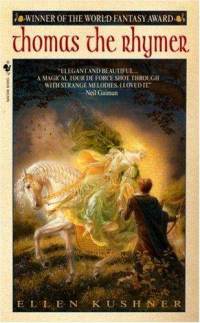
Thomas the Rhymer - Ellen Kushner


The best thing about this story is the music.  You could almost see yourself in the halls of the kings and nobles, in the gardens and fountains, and in the magical realm of Elfland, immersed in the powerful music and magic of minstrelsy.  Seldom have I encountered a book with so much music and sound in it.  You will hear the susurration of silks, the rustling of leaves, the baa-ing of sheep, stories of tragic loves and heroic rescues, and music, music, music. It’s wonderful to hear music from your own imagination, brought to you by the power of words on a page.


The book gives us the life of Thomas, a minstrel.  We meet him first when, as a young travelling harper trying to find escape from the consequences of his youthful indiscretions, he finds himself in the care of a farmer and his wife deep in the quiet countryside.  He sings them his songs, new and old, and shares with them the gift of his music. The couple takes him in and is soon as fond of him as if he was their own child.  There among the hills, ranges, meadows, and music he meets Elspeth.  Their love is young and innocent, playful and easy.  But Thomas’ fate takes a drastic turn when one day while taking a stroll through the trees, he encounters the wondrous Queen of Elfland, who strikes a bargain with him and takes him from Earth and into her magical realm to be her lover and servant for seven years. 


In Elfland Thomas meets many strange and wonderful characters.  Hunter, the queen’s brother, tries to challenge him at every turn.  Thomas’ invisible servant sees to his needs but also hides a grim and sad story of her own.  There is the dove that weeps tears of blood when it hears Thomas’ music – bespelled by Hunter.  There is the King Who Waits, who calls Thomas “brother” and with whom Thomas feels a strange bond.  And then of course, the Queen.  He serves as her harper and singer in the halls and as the lover in her bed.  Thomas’ time in Elfland is full of magical stories, mysteries and riddles that he must solve, as well as innocents he feels compelled to save from cruel fates.  His true mettle as a minstrel is tested there, and he learns more about himself and about life and death from his incredible experiences.  At the end of seven years, and as a reward for solving a riddle and making a noble sacrifice, the Queen returns him to Earth with the gift of “a tongue that cannot lie.” 


I will leave the rest of the story for you to discover.  It is filled with magic and music.  If you enjoy a good, colorful fantasy enhanced by lyrical and imaginative storytelling, then you will appreciate this book.  It is a winner of the World Fantasy Award and Mythopoeic Fantasy Award.  It also strongly reminded me of the tale of “Tam Lin” (I think it might be based loosely on this folk tale because of the many similarities and direct references.) and “Jonathan Strange and Mr Norrell” which I also enjoyed immensely and consider as one of the most memorable books I ever read.  In any case, I believe "Thomas the Rhymer" is definitely worth reading.  Enjoy

Tuesday, July 17, 2012

Switch Girl 2011 (スイッチガール!!)


I decided to try this out on a whim because I felt a little bit swamped by some rather serious stuff lately.  I craved for a little bit of nonsense and slapstick humor.  Sometimes you just want to forget about the world around you and laugh yourself silly.  Sure enough, this series gave me that much needed break. 

“Switch Girl” is based on a manga of the same name.  The premise presents us with a heroine, Nika, a high school student who takes drastic measures to put up a façade of perfection and popularity at school while hiding her true slovenly self.  Surely any woman of any age can relate to this.  We all agonize over the image we present to the world whenever we step out of our comfort zone.  I loved the fact that this story pulled no punches.  It threw everything at the world, from “safety panties” to deodorizing one’s farts.  I found it totally refreshing that the main character was perfectly comfortable with her imperfections.  The daily ritual of transforming herself was just another way for her to have fun in her life – it neither defined her nor turned her obsessive and psychotic.  She was perfectly able to let her true self shine through whenever the need for honesty arose. 

As a counterpoint comes Arata, a good-looking boy who in exact reverse of Nika hides behind thick glasses to avoid becoming popular.  He faces abandonment issues from when his mother left their family after he caught her having an affair with another man.  He discovers Nika’s secret and they make a deal not reveal each other’s true selves to the rest of the school.  Their relationship starts from there.  Nika and Arata, trying to get to know each other more, trying to get by in school, trying to outwit those who antagonize them – with their wacky friends and Nika’s equally crazy mother and elder sister thrown into the bunch, make for a perfectly loony series.

It all sounds shallow and silly, I know, but I found the situations rather entertaining.  It felt like it was meant to be that way – coarse, upfront, and exaggerated.  With only eight episodes and each episode at only thirty minutes long, it didn’t feel overdone.  If you’re looking for nothing heavy and just want a few laughs, you’d probably like this one.  Enjoy!